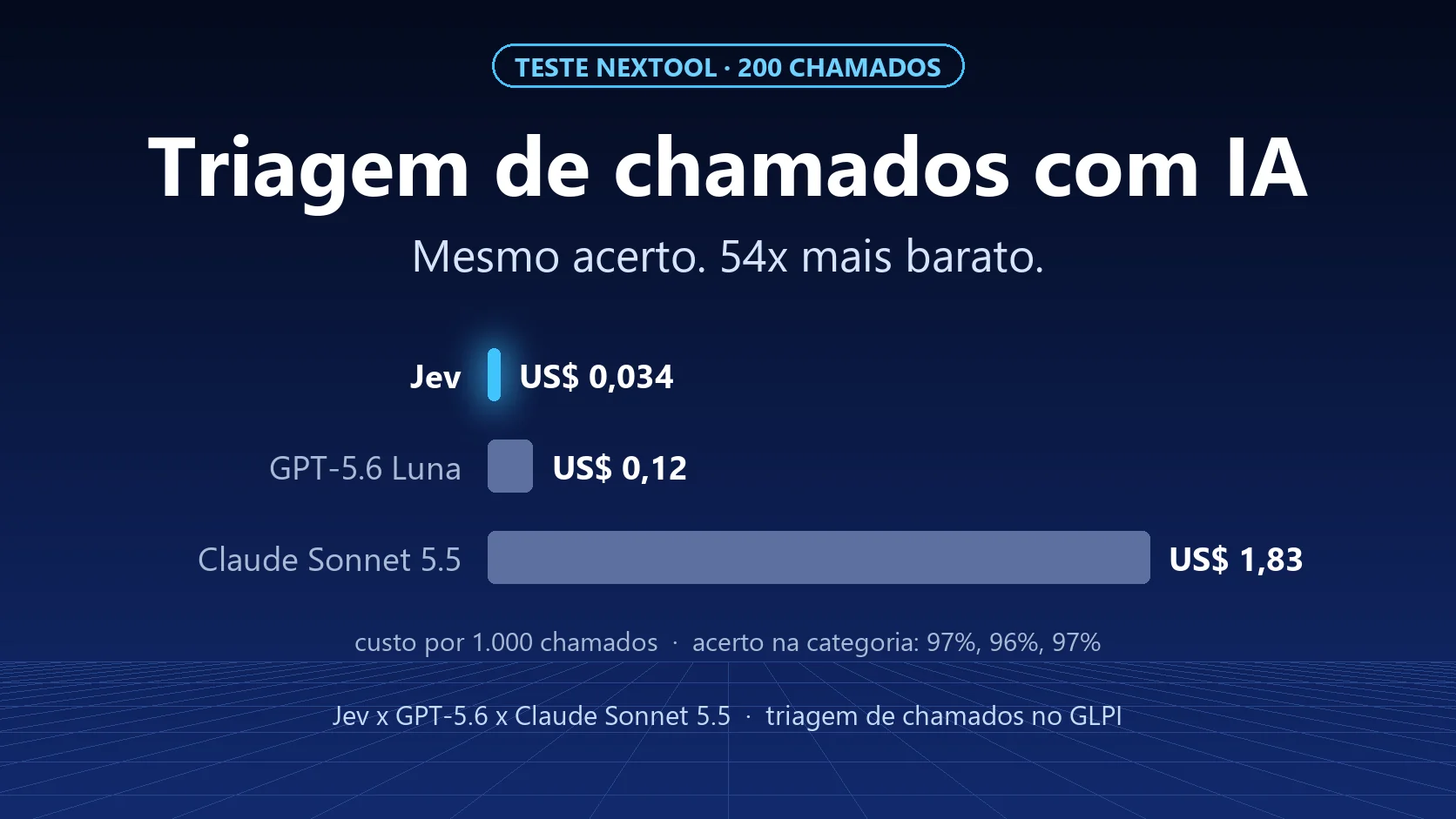
Classifying a thousand tickets with AI cost US$ 0.034 with Jev, US$ 0.12 with GPT-5.6 Luna and US$ 1.83 with Claude Sonnet 5.5. All three got the category right 96% to 97% of the time. We ran the test with 200 tickets from a fictitious service desk to answer a question almost nobody asks before putting AI in front of support: to triage a ticket, do you really need a model that writes?
The bottleneck nobody measures: triage
Every ticket goes through three decisions before anyone starts working on it: which category, whether it is an incident or a request, and how urgent it is. When triage gets it wrong, the ticket lands in the wrong queue, waits, gets reclassified, and the SLA clock runs against the team. In many operations, triage is still manual, done by first-level support between one call and the next.
It is a decision task, not a writing task. That is why the launch of Jev caught our attention.
What Jev is and why it is different
Jev was launched by TypeSafe AI on September 15, 2026 and has been available through OpenRouter since September 18. It does not generate text. You send the context (the ticket text) and typed questions, and it returns:
- a choice among defined options (for example, the category);
- yes or no, with the probability (for example, whether it is an incident);
- a score on a scale (for example, urgency).
For each answer it reports the confidence. And since it does not write, you pay basically for the input: US$ 0.042 per million tokens, according to the vendor. An LLM, even when asked for a short JSON, charges for input and output and takes longer to answer.
How we ran the test
- 200 fictitious tickets from a made-up company, Acme: 25 per category (network, access, ERP, e-mail and Office, printer, hardware, software, telephony), written the way users really write, in a hurry, with abbreviations and two problems in the same text. No real data. The tickets were written in Portuguese.
- Answer key defined before the test: the category, the type (incident or request) and the urgency (low, medium, high, critical), with written rules for each level. Sixteen tickets are ambiguous on purpose, the kind an analyst would also hesitate on.
- The same questions and definitions for all three models, through OpenRouter, with temperature zero and providers that do not retain data: Jev 1.13, GPT-5.6 Luna (OpenAI's low-cost model) and Claude Sonnet 5.5 (a frontier model from Anthropic).
- We measured accuracy, response time and the cost of each call. The whole test cost about US$ 0.40.
The results
| Jev 1.13 | GPT-5.6 Luna | Claude Sonnet 5.5 | |
|---|---|---|---|
| Correct category | 97.0% | 96.0% | 97.0% |
| Incident or request | 97.0% | 98.0% | 98.0% |
| Exact urgency | 83.5% | 85.0% | 84.5% |
| Urgency within 1 level | 99.5% | 100% | 100% |
| All three answers right | 79.0% | 81.0% | 82.0% |
| Category on the 16 ambiguous tickets | 93.8% | 87.5% | 87.5% |
| Response time (median) | 0.66 s | 1.6 s | 2.1 s |
| Cost per 1,000 tickets | US$ 0.034 | US$ 0.12 | US$ 1.83 |

On accuracy, a statistical tie: the difference between the three is one or two tickets out of two hundred. On cost, Jev came out 54 times cheaper than Claude Sonnet 5.5 and almost 4 times cheaper than GPT-5.6 Luna. On time, it answered 2.5 to 3 times faster, with little variation: 95% of the answers came back in under 0.75 s.
TypeSafe advertises a workflow "444 times cheaper than a frontier LLM". We did not reproduce that number, and that is not strange: their comparison uses a different task and a different model. In our test, the advantage was 54 times against a frontier model, which already changes the math for any operation.
What only the classifier delivers: confidence
The most useful finding is not in the accuracy table. It is the confidence Jev returns with each answer. With it, you can decide when the AI triages on its own and when an analyst takes a look:
| AI decides alone when confidence is at least | Tickets triaged automatically | Accuracy on those tickets | Sent to an analyst |
|---|---|---|---|
| 0.5 | 99.0% | 97.0% | 2 |
| 0.7 | 93.5% | 98.9% | 13 |
| 0.8 | 90.0% | 98.9% | 20 |
| 0.9 | 85.0% | 98.8% | 30 |
With the threshold at 0.7, 93.5% of tickets would be triaged with no one involved, at 98.9% accuracy, and 13 out of 200 would go to the human queue. An example of what that threshold catches: the ticket "we got an e-mail asking for passwords and two colleagues typed theirs in", a phishing attack, was classified as e-mail with 0.68 confidence. Below the threshold, it would fall to an analyst, which is exactly where it belongs.
LLMs can also return a "confidence" if you ask for it, but it is text the model writes, not a calculated probability. For deciding automation, that makes a difference.
Where all three got it wrong
The mistakes say more than the hits:
- Three tickets all three models got wrong the same way. "My user shows the wrong name in Teams and e-mail" (access or e-mail?), "enable the approver profile in the ERP" (access or ERP?) and "the HR system won't open after the update" (software or ERP?). In all three, our own category definitions allow two readings. The lesson: the taxonomy matters more than the model. Before choosing the AI, review your categories.
- Urgency is everyone's weak spot, with about 15% error, almost always by one level. Jev tended to raise the urgency of medium tickets and rated two critical situations (a building-wide internet outage and the ERP down) as high. GPT-5.6 Luna tended to lower medium ones to low. Critical urgency, affecting several departments or billing, needs a business rule, not just AI.
- On the ambiguous tickets, Jev did better (93.8% versus 87.5% for both LLMs).
What this changes for GLPI users
GLPI already handles a good part of triage with business rules: keywords in the title, the ticket source, the form. The problem is the ticket that arrives by e-mail, written however the person managed to write it. That is where a low-cost classifier comes in:
- Rules first. Whatever can be decided by a rule, decide by rule: it is predictable and free. In NexTool, the Ticket Rules module categorizes and fills in the ticket automatically by rules.
- A classifier for the rest, with the confidence threshold deciding what goes to a human.
- Assignment after the right category. With the category set, Smart Assign distributes tickets among the group's technicians, by load balancing or round robin. See how automatic assignment works in GLPI.
- An LLM where it is irreplaceable: summarizing the history, suggesting a reply and turning a solved ticket into an article, which is what AI Assist does (AI to summarize and answer tickets in GLPI).
Using a frontier LLM to triage tickets is like calling in the specialist to sort the mail: it works, but it is expensive and slow.
Before going to production
- Your own data: our test used fictitious tickets, in Portuguese, written by us. Run the same test with a sample of your tickets (anonymized) before trusting the number.
- Calibration: the right confidence threshold depends on your data. Start conservative (0.8 or 0.9) and lower it over time.
- Privacy: the ticket text leaves your environment. Choose providers that do not retain data, strip personal data when possible and record this in your data protection impact assessment (GDPR, LGPD).
- A single run: we ran each model once, without tuning prompts or criteria for each one.
Conclusion
For ticket triage, the most expensive model was not more accurate. What set the three apart was cost, time and calibrated confidence, which lets you automate safely. The right question before putting AI in your service desk is not "which model is best" but "which task am I solving". In the next article, we use these numbers to answer another one: how much AI costs per ticket.
Want to review triage and assignment in your GLPI? Talk to the team.
Test run by the NexTool Solutions team on October 1, 2026, with 200 fictitious tickets and OpenRouter prices on that date. Models: typesafe/jev-1.13, openai/gpt-5.6-luna and anthropic/claude-sonnet-5.5.