GLPI 12 now has a date to leave the testing phase: RC1 was published on September 3, RC2 on September 16, 2026, and Teclib promises the stable version for October. We installed the release candidate and showed everything in a live stream with JMBA Soluções. Here is what we saw in practice, what stays the same as GLPI 11 and, above all, when it is worth upgrading.
Watch the live stream: First impressions of GLPI 12, on JMBA Soluções’ YouTube channel (68 minutes, September 8, 2026, in Portuguese). For the development overview, with the interface modernization, the APIs and the Docker environment for testing, also read GLPI 12: what we already know and how to test the new version.
Where GLPI 12 stands: RC1, RC2 and stable in October
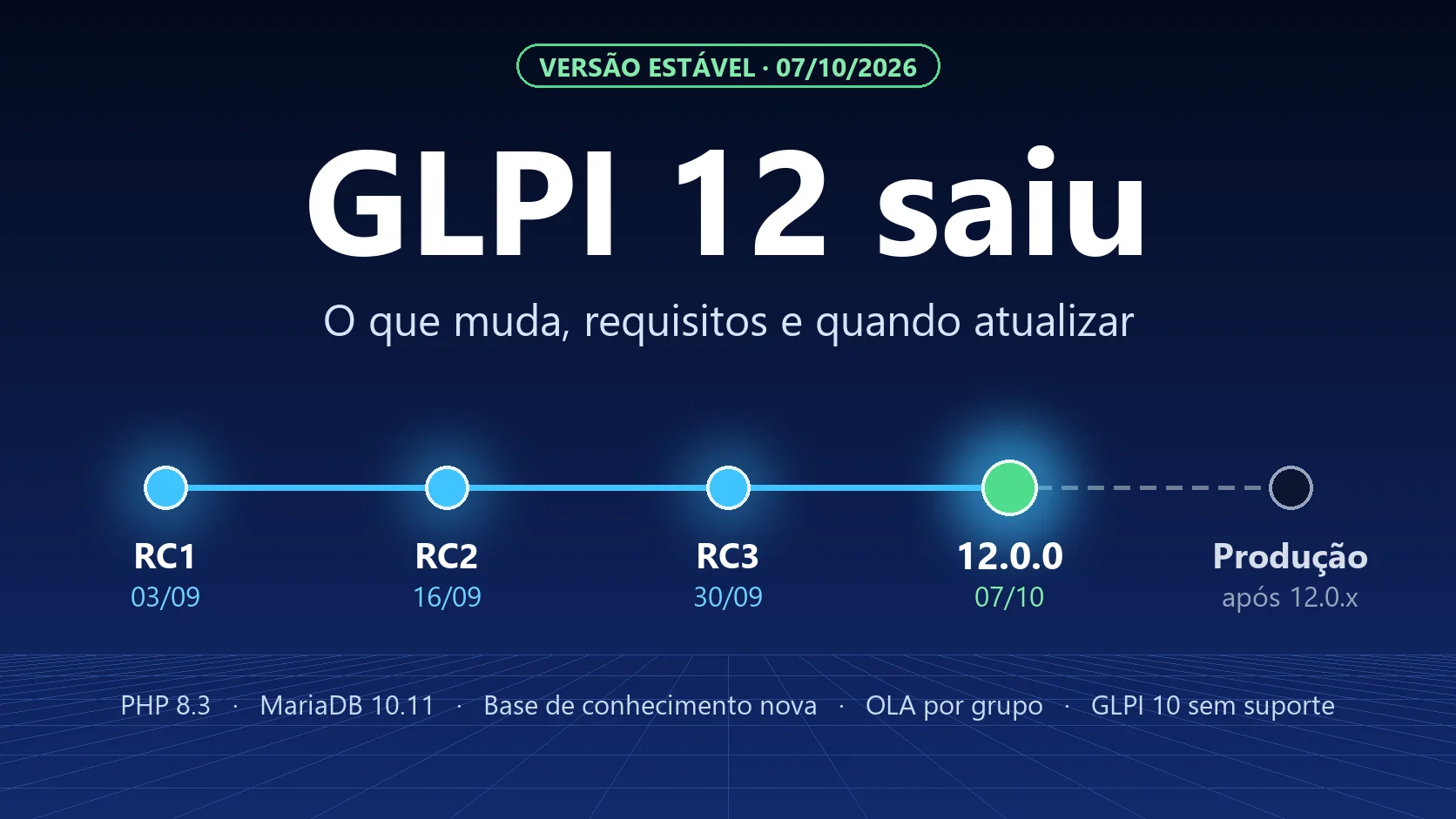
A release candidate is the phase in which the code is practically frozen and the project asks the community to test before the final version. The timeline so far:
| Milestone | Date |
|---|---|
| GLPI 12.0.0 RC1 | September 3, 2026 |
| GLPI 12.0.0 RC2 | September 16, 2026 |
| GLPI 12.0.0 stable | promised by Teclib for October 2026 |
The RC2 release page on GitHub itself opens with the warning that this is an RC version that must not be used in production. On the same day, September 16, GLPI 11.0.9 and 10.0.27 were also released, as maintenance versions for those on the current lines.
It is worth understanding Teclib’s new release cadence, because it changes how GLPI administrators plan: security fixes every month and one major version per year. GLPI 10 came out in 2022 and 11 in 2025; with the new cadence, 12 arrives one year after 11. In practice, a major upgrade stops being a rare event and becomes part of the IT team’s yearly calendar.
How we tested GLPI 12 RC
In the September 8 live stream, the JMBA Soluções team installed GLPI 12.0.0 RC, walked through the new screens live and compared everything with GLPI 11, with NexTool taking part. GLPI’s own About screen warns that the version is unstable, and that is how the notes below should be read: they are impressions of a release candidate, and details may still change before the stable version. Whenever possible, we checked each point against the project’s official changelog.
What does not change: the interface is still the GLPI 11 one
Anyone expecting a new look will be surprised. The login screen and the everyday interface are practically the same as in GLPI 11. For end users and technicians, the version change is barely visible on screen, which is good news for training and internal communication.
The changes in GLPI 12 are concentrated on three fronts: security, administration (profiles and OLA) and the knowledge base. Those are the reasons to look at the new version.
Security: GLPI 12’s big bet
This was the area with the most new features in the RC. The release notes highlight the re-authentication mode, the sessions manager and the hardening against SQL injection and CSRF.
Re-authentication on sensitive actions
Sensitive administrative actions now ask for the password again, even for the super-admin. The scenario this solves is well known: an administrator’s session left open on a shared computer. In RC2 the screen appears as “Re-authentication required”. The behavior can be turned off by a configuration constant, which we do not recommend without a good reason.
A dedicated Security menu
The password policy and 2FA moved out of Setup > General into their own menu, Setup > Security. It becomes easier to find and audit everything that protects access to GLPI.
Active session management, with a Revoke button
GLPI 12 lists open sessions with type, user, browser, operating system, IP, last activity and status. The Revoke button kills the session immediately. Besides the obvious use, ending a suspicious access, it solves an old annoyance: after changing someone’s profile, you can force a new login so the change takes effect right away.
Each user’s record shows the list of their sessions. If the same user is connected at the same time from two different IPs, it is a sign of a shared or leaked password, and now this is visible without querying the database.
A detail for those who publish GLPI behind a reverse proxy: the changelog brings stricter client IP detection, with the GLPI_TRUSTED_REVERSE_PROXIES and GLPI_REVERSE_PROXY_HEADERS constants. Configure both during staging, or the session list will tend to show the proxy IP instead of the user’s IP.
Data retention and automatic cleanup
A new Setup > Data and Privacy menu centralizes retention policies: for the historical logs, which moved out of Setup > General, and for the session history, cleaned by a new automatic action whose execution status is shown on screen. It is the end of log tables that grow unchecked and weigh on the database and the backup.
Under the hood, the RC brings fixes for SQL injection and other vulnerabilities. Some of them are also reaching GLPI 11 through maintenance versions, one more reason to keep 11 up to date while 12 matures.
Profiles that hide search fields
The profile now controls which fields appear in the user’s search and filters. You can hide, for example, requester, observer, OLA, satisfaction survey or the map filter, making the end user’s search simpler and free of options they do not use. If you are reviewing profiles, the guide Profiles and permissions in GLPI is still a good foundation.
OLA with its own group
Each OLA can now have its own group. Today, teams that use OLA per group usually rely on business rules to recalculate the level when the ticket changes group; with the group tied to the OLA, part of that logic leaves the rules. To review the concepts, see SLA and OLA in GLPI: complete configuration guide.
Knowledge base: the most visible change
If there is one screen that really changed in GLPI 12, it is the knowledge base:
- New interface, with categories in a tree and icons from the library or from your own image.
- Markdown editor: article authors no longer need to deal with HTML.
- Public link: an article can be shared through a link with a key, which you can turn off whenever you want.
- Revision history and comments in the article sidebar.
- Article in the service catalog, with description, icon and category. When opening a ticket, the user lands directly on the article and can solve the issue alone.
What does not exist yet: GLPI 12 does not suggest articles while the user types the problem. In GLPI 11, that is what NexTool’s AI Assist module does, as we showed in AI for the GLPI knowledge base.
Watch out when upgrading: according to the official changelog, knowledge base categories become articles, organized under a root article, and visibility is now inherited down the tree. On upgrade, existing categories become invisible until access to them is granted again. In a knowledge base with many articles, this must be in the staging test plan, or users will open the knowledge base and find content missing.
Other changes worth knowing
- User record: a new middle name (patronymic) field and input masks on date fields.
- Automatic actions: they gained an error status, after repeated failures, and an aborted status. If your monitoring reads the GLPI status checker, the automatic actions service text changed and now includes the error count.
- Remember me now works on several devices at the same time.
When to upgrade to GLPI 12
The recommendation we gave in the live stream, and that we keep here:
- Now, during the RC: no production, and no staging yet either. Use the RC only in an isolated environment, to get to know it.
- From November: with the stable version released in October, start staging with a copy of your database.
- Production: only after about two security updates of the 12 line, which should happen around January or February 2027.
The logic is simple: the first stable release of a major version always receives fixes in the following weeks. With Teclib’s monthly cadence, waiting for two of them costs little time and keeps your team from being the first to hit each problem.
| You are on | What to do now | Next step |
|---|---|---|
| GLPI 10 | Migrate to GLPI 11 | Go from 11 to 12 after it stabilizes |
| GLPI 11 | Keep it updated (11.0.9 or later) | Stage 12 from November |
| Just want to see 12 | Test the RC in an isolated environment | Take the list of impacts to staging |
What about those still on GLPI 10?
Do not wait for 12. Move to GLPI 11 now: it is stable, and form migration became smooth from version 11.0.4 onwards. Then go from 11 to 12 following the calendar above. Jumping straight from 10 to 12 packs two big migrations into a single project, with twice as many things that can go wrong. The step by step is in How to migrate from GLPI 10 to GLPI 11.
Checklist for any GLPI upgrade
- Take stock of everything: current version, plugins, integrations, business rules, forms and customizations.
- Check each plugin’s compatibility. In GLPI 12 this matters more: CSRF protection is now based on browser headers, and the old tokens must be removed from plugin forms. A plugin without a version tested for 12 is a risk. See the criteria in GLPI plugins: how to choose without blocking the next upgrade.
- Back up the database and files, and test the restore. The procedure is in GLPI backup and disaster recovery.
- Stage with a copy of production: ticket creation, forms, notifications, rules, integrations and, in GLPI 12, knowledge base visibility.
- Have a rollback plan with a decision deadline: if something critical fails, roll back and fix it calmly.
In JMBA’s upgrade projects, this cycle takes six weeks on average. Starting staging in November leaves production ready with room to spare for early 2027.
Next step
NexTool brings together more than 34 modules for GLPI, several of them free, currently focused on GLPI 11. See the full catalog at GLPI plugins. In the same live stream, JMBA presented JMBA Hub, a free GLPI ticketing app for Android, open to testers: see how to join in JMBA Hub: how to test the app?
Planning your upgrade to GLPI 11 or to 12? Talk to our team.
Reviewed by the NexTool Solutions team. Observations made on GLPI 12.0.0 RC in September 2026; details may change before the stable version.