


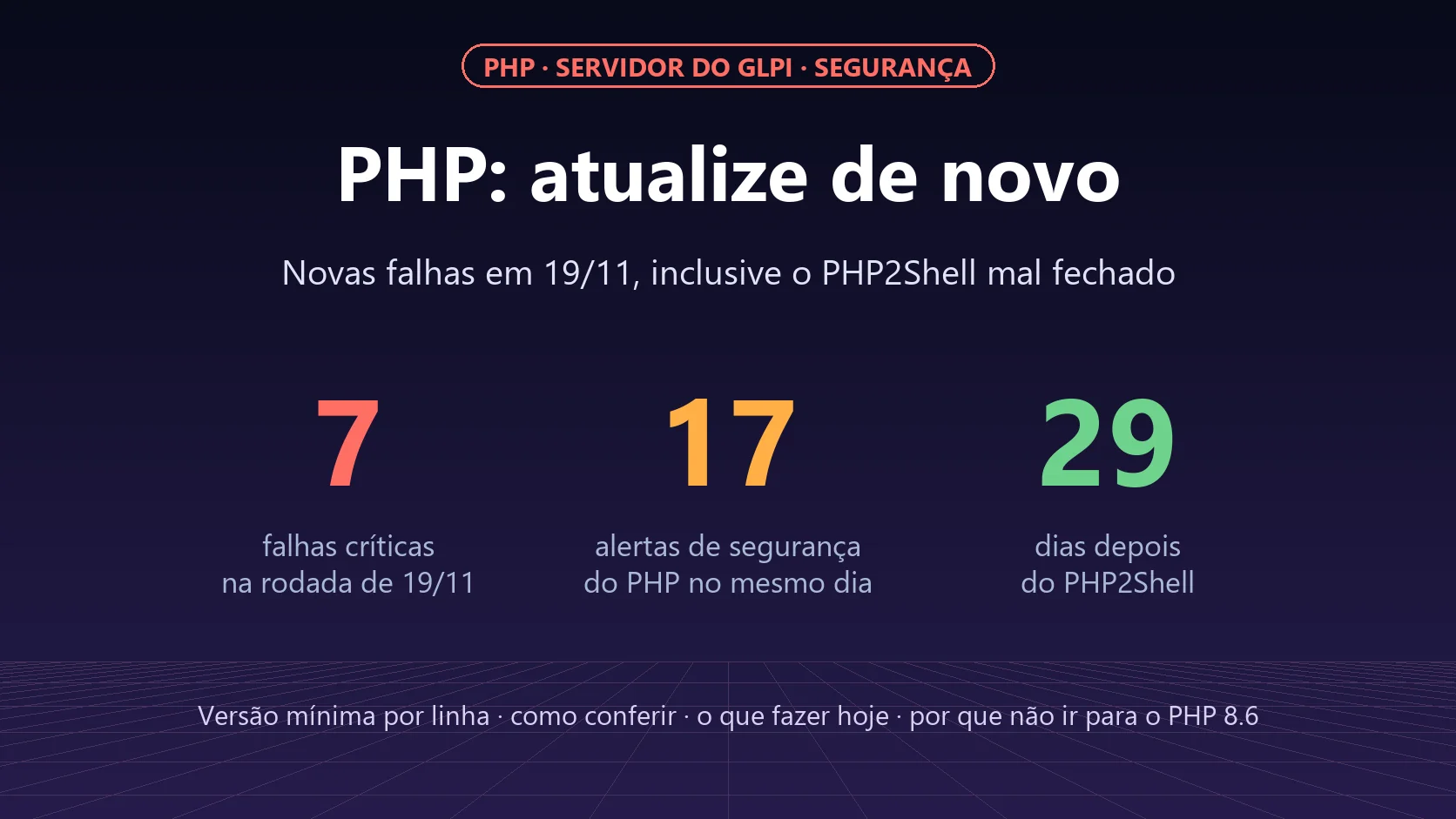
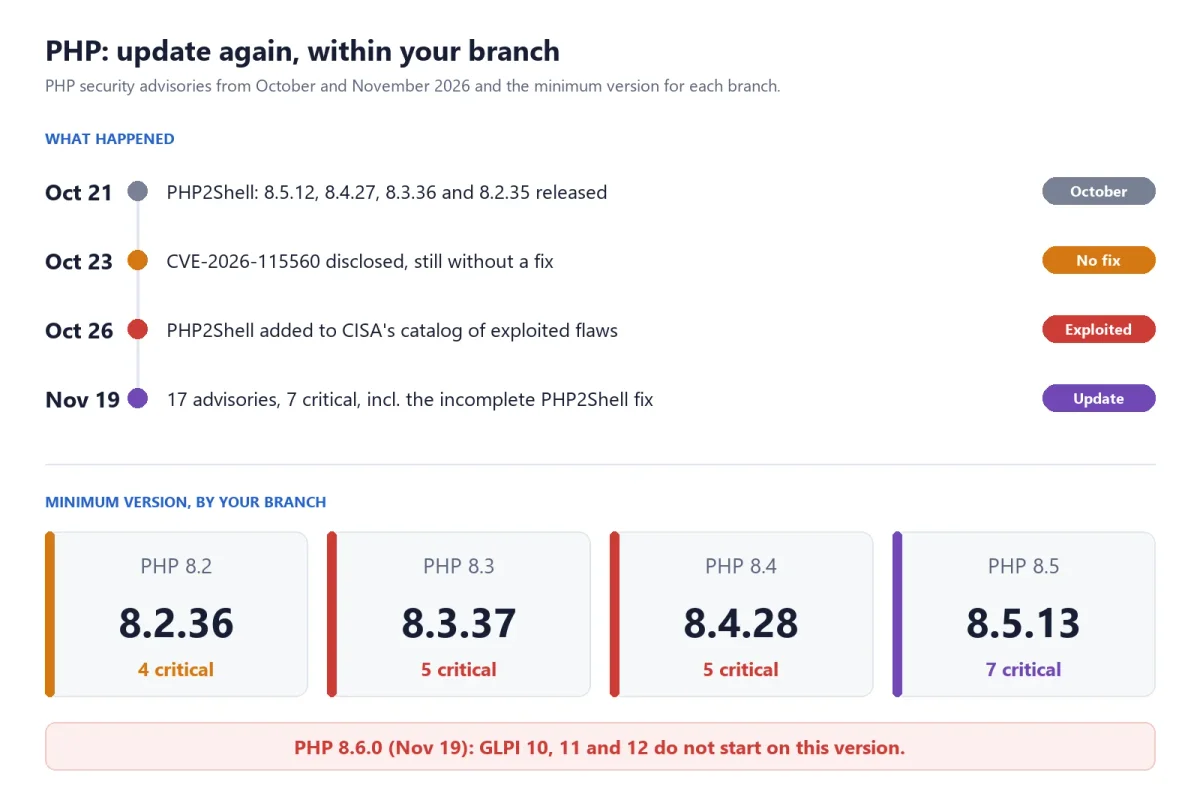
On November 19, 2026, PHP released versions 8.5.13, 8.4.28, 8.3.37 and 8.2.36, with 17 security advisories. Seven are critical. Two of them continue the PHP2Shell story: one is an incomplete fix for CVE-2026-109619, and the other finally fixes CVE-2026-115560, the upload progress flaw that had been unpatched since October 23. If you updated to 8.5.12, 8.4.27, 8.3.36 or 8.2.35 because of PHP2Shell, you are once again on a version with known flaws. The flaw is in the PHP installed on the server, not in GLPI: updating GLPI or a plugin does not fix it. Below: what changed, the minimum version for each scenario, how to check, what to do if you cannot update today, and why this is not the time to jump to PHP 8.6.
Summary for those with five minutes
| Question | Short answer |
|---|---|
| What was released? | PHP 8.5.13, 8.4.28, 8.3.37 and 8.2.36, on Nov 19, 2026, with 17 security advisories |
| How severe is it? | 7 critical (CVSS 4.0 score 9.2). How many affect you depends on the branch: 4 on 8.2, 5 on 8.3 and 8.4, 7 on 8.5 |
| Is it related to PHP2Shell? | Yes. One is an incomplete fix for CVE-2026-109619 and another fixes CVE-2026-115560, from Oct 23 |
| I updated in October. Do I need to update again? | Yes. The October versions are on the list of affected versions |
| Is GLPI affected? | It runs on PHP, so yes. File-based sessions, the target of the flaw nicknamed "phpAfterShell", are the default in PHP and in GLPI |
| Is it already being exploited? | As of Nov 24, none of the flaws is in CISA's Known Exploited Vulnerabilities (KEV) catalog |
| Do I need to restart? | Yes: PHP-FPM or Apache. In Docker, recreate the container with the new image |
| Can I take the chance to move to PHP 8.6? | No. GLPI 10, 11 and 12 do not start on PHP 8.6 |
What was released on Nov 19
On November 18, PHP announced that the next day's regular security release would include critical-severity flaws and that these flaws require non-default configuration or unusual setups. On the 19th, the fixed versions and the 17 advisories came out, published in PHP's GitHub repository.
| PHP branch | Minimum version | Advisories fixed | Critical |
|---|---|---|---|
| 8.2 | 8.2.36 | 12 | 4 |
| 8.3 | 8.3.37 | 13 | 5 |
| 8.4 | 8.4.28 | 14 | 5 |
| 8.5 | 8.5.13 | 17, plus one CVE in the uriparser library | 7 |
PHP 8.1 and earlier get no fixed release from the PHP project, and most of the advisories apply to everything below 8.2.36. If you run the PHP 8.1 that ships with Ubuntu 22.04, the fix comes from Canonical itself (package 8.1.2-1ubuntu2.29).
The seven critical flaws
| Advisory | Branches | What it is | Requires |
|---|---|---|---|
| CVE-2026-126714, the "phpAfterShell" | all | If writing a session file is interrupted, the file ends up with the start of the new session and the end of the old one. On the next read, PHP may create objects chosen by the attacker | influence over the session content, an interruption at the right point, and classes on the system that can act as "gadgets" |
| CVE-2026-129289 | all | Request smuggling in PHP-FPM: bytes from the body of one request become a second request, which runs the attacker's PHP without authentication | a web server that reuses the connection to PHP-FPM and an application that opens the request body without reading all of it |
| CVE-2026-129481 | 8.3 and later | Incomplete fix for PHP2Shell (CVE-2026-109619): PHP keeps a pointer to memory that has already been freed after an interrupted session shutdown | a fatal error during session cleanup. Code execution not demonstrated |
| CVE-2026-129182 | 8.5 only | New scenarios of the same PHP2Shell flaw, which 8.5.12 did not cover | a fatal error during request shutdown |
| CVE-2026-115560 | all | The Oct 23 flaw: upload progress writes the session in one format and another part reads it in another | two session formats in the same storage |
| CVE-2026-129496 | all | Use-after-free in the time zone cache, triggerable without authentication | PHP error log written to a file and a warning emitted at PHP startup |
| CVE-2026-129474 | 8.5 only | Use-after-free when building the backtrace of __call() methods, triggerable without authentication |
a fatal error inside that kind of method |
The nickname "phpAfterShell" circulates in the security press. In PHP's advisories it is just CVE-2026-126714.
What this has to do with GLPI
- File-based sessions. GLPI stores sessions in files, in the
files/_sessionsfolder, with PHP's default handler (files). That is exactly what CVE-2026-126714 hits. You only avoid this path if you moved sessions to another storage, such as Redis. - Classes that become gadgets. The CVE-2026-115560 report shows command execution using classes from the Guzzle and Monolog libraries. Both ship with GLPI 12: we checked the
vendorfolder in our lab. This does not prove that GLPI is exploitable, but it takes "I don't have those classes" off the list of defenses. - Request body. The GLPI API and inventory read the request body (
php://input). We did not test whether any GLPI path leaves the body unread. If your web server reuses the connection to PHP-FPM, treat the server as exposed to CVE-2026-129289. - glpi/glpi Docker image. It uses Apache with mod_php, without PHP-FPM. CVE-2026-129289 does not apply to it, but the session flaws do.
Is it already being exploited?
The picture is different from PHP2Shell. The two October CVEs were added to CISA's catalog of exploited flaws on Oct 26. As of Nov 24, none of the Nov 19 flaws is in that catalog, and we found no public report of exploitation. PHP itself warned that the critical ones depend on non-default or unusual configuration.
That gives you time to do it right: backup, test copy and maintenance window. It is no reason to leave it for next month. The fixes and the technical details have been public since Nov 19, and whoever is going after PHP2Shell already knows where to look.
Step 1: see which PHP serves GLPI
In GLPI: Setup > General > System. The server section shows the PHP version that GLPI is using.
On the server, check the command-line PHP and the one that serves the web, which may be a different one:
php -v
systemctl list-units --type=service | grep -Ei 'php|apache|httpd'
sudo php-fpm8.3 -v
Replace 8.3 with the version that shows up in the service list. On Red Hat and derivatives, use sudo php-fpm -v. In Docker: docker exec <container> php -v.
Step 2: compare with the minimum version for your scenario
| Scenario | Minimum fixed version | Note |
|---|---|---|
| Compiled PHP, sury/ondrej, Remi or Windows | 8.2.36, 8.3.37, 8.4.28 or 8.5.13 | Same number as on php.net |
| Ubuntu 24.04 (distribution PHP 8.3) | package 8.3.6-0ubuntu0.24.04.14 | The number stays 8.3.6. The package came out on Nov 20 |
| Ubuntu 22.04 (distribution PHP 8.1) | package 8.1.2-1ubuntu2.29 | Fixed by Canonical |
| Debian 13 | 8.4.28-1~deb13u1 | Advisory DSA-6641-1 |
| Debian 12 | 8.2.36-1~deb12u1 | Advisory DLA-4916-1 |
| Docker Hub php image | tags 8.2.36, 8.3.37, 8.4.28 and 8.5.13 | Tags such as 8.3-fpm and 8.2-apache already point to the fixed versions |
| glpi/glpi image | tags 12.0.2, 11.0.13 and latest | PHP 8.5.13 since Nov 22. The 10.0.28 tag was still on PHP 8.5.12 on Nov 24 |
With distribution PHP, the version number may not change. Check the changelog of the installed package:
zcat /usr/share/doc/php8.3-common/changelog.Debian.gz | grep -E 'CVE-2026-(126714|129289|129481)'
rpm -q --changelog php-common | grep -E 'CVE-2026-(126714|129289|129481)'
The first one is for Ubuntu and Debian (replace 8.3 with your version), the second for Red Hat and derivatives. If the CVEs show up, the package has the fix.
Step 3: update and restart
The path is the same as in October, scenario by scenario, in our PHP2Shell guide. In short:
sudo apt-get update && sudo apt-get install --only-upgrade 'php8.3*'
sudo dnf update 'php*'
sudo systemctl restart php8.3-fpm
sudo systemctl restart apache2
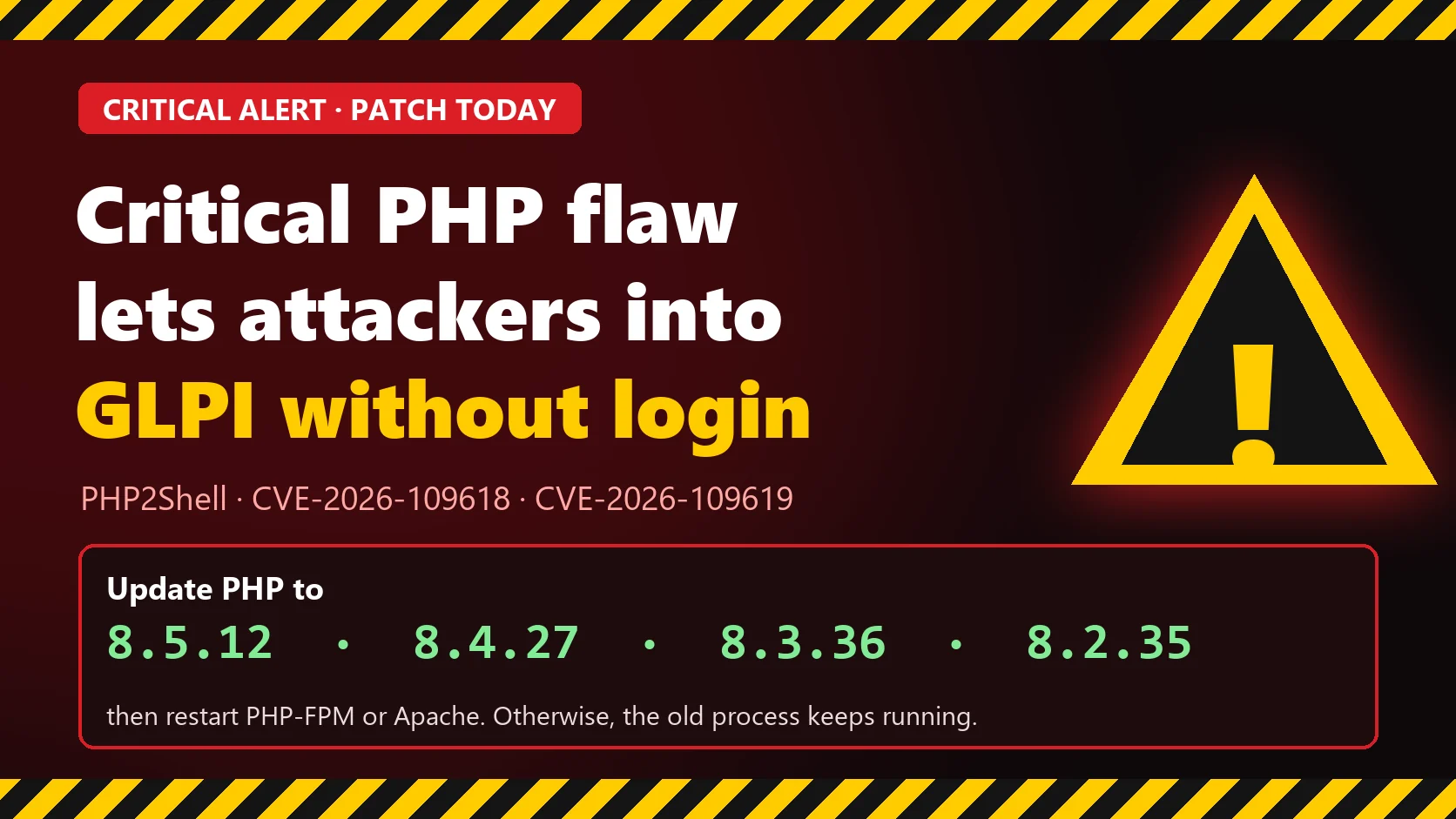
Use your distribution's command and your service name (on Red Hat, php-fpm and httpd). Without a restart, the old process stays up with the vulnerable code. Then open Setup > General > System again and check. On Ubuntu, sudo needrestart -r l lists what is still running old code.
Three things to watch with Docker:
- Pin the PHP branch in the tag. On Nov 24, the
php:apache,php:fpmandphp:latesttags already pointed to PHP 8.6.0, which GLPI does not accept. Usephp:8.3-fpm,php:8.5-apacheand the like. - Recreate the container. Restarting the old container does not replace PHP:
docker compose pull glpianddocker compose up -d glpi, with the database and thefilesandconfigfolders on volumes. - GLPI 10 in Docker. The
glpi/glpi:10.0.28tag had not been rebuilt yet as of Nov 24. Until a new image comes out, apply the measures in Step 4. GLPI 10 has been out of support since Sep 30: one more reason to plan your way out.
Step 4: if you cannot update today
| Measure | Reduces the risk of | How |
|---|---|---|
| Disable session upload progress | CVE-2026-115560 and one of the paths of CVE-2026-126714 | session.upload_progress.enabled = Off in php.ini or php_admin_flag[session.upload_progress.enabled] = off in the PHP-FPM pool |
| Do not reuse the connection between the web server and PHP-FPM | CVE-2026-129289 | nginx without fastcgi_keep_conn on; Apache without enablereuse=on. The default in both closes the connection after each request |
| Do not expose the PHP-FPM port | CVE-2026-129289 | The PHP-FPM port (usually 9000) must not be reachable from untrusted networks |
| One worker per request | CVE-2026-129481 | pm.max_requests = 1 in the pool. It costs performance: use it only as a stopgap |
| On PHP 8.5, disable fatal error backtraces | CVE-2026-129182 and CVE-2026-129474 | fatal_error_backtraces = 0 and zend.exception_ignore_args = 1 |
| Clear PHP startup warnings | CVE-2026-129496 | Fix deprecated settings that raise a warning when PHP starts, or send the error log to syslog |
| Take GLPI off the internet | all | Access only through the VPN or an allowlist of addresses until you update |
To check what is actually in effect, look at PHP-FPM, not at the command-line PHP:
sudo php-fpm8.3 -i | grep -E 'session.upload_progress.enabled|fatal_error_backtraces|zend.exception_ignore_args'
grep -rn 'fastcgi_keep_conn' /etc/nginx/
grep -rni 'enablereuse' /etc/apache2/ /etc/httpd/ 2>/dev/null
GLPI does not use session upload progress, and the other settings change nothing for users. The exception is pm.max_requests = 1, which makes the server slower.
The new version disables upload progress by default. If your php.ini or pool has a line that enables the feature, it still applies after the update. We already recommended disabling it on Oct 23: check whether that line is still there.
Do not take the chance to jump to PHP 8.6
PHP 8.6.0 came out on the same day, Nov 19. GLPI does not accept this version yet, and it is not just a recommendation: the first thing GLPI does is check the PHP version and stop.
| GLPI version | Accepted PHP | On PHP 8.6 |
|---|---|---|
| GLPI 10.0.28 | 7.4 to 8.5 | Stops with "PHP 7.4.0 - 8.6.0 (exclusive) required" |
| GLPI 11.0.13 | 8.2 to 8.5 | Stops with "PHP version must be between 8.2 and 8.5." |
| GLPI 12.0.2 | 8.3 to 8.5 | Stops with "PHP version must be between 8.3 and 8.5." |
Stay on your branch and raise only the last number. Two notes for planning: PHP 8.2 receives security fixes until December 31, 2026, so if you are on GLPI 11 with PHP 8.2 you should schedule the move to 8.3 or newer. And if you still run PHP 8.1, you are usually on GLPI 10, out of support since Sep 30. The risks of staying and the migration roadmap are in still on GLPI 10? The risks of staying and the roadmap to migrate.
Timeline
| Date | What happened |
|---|---|
| Oct 21, 2026 | PHP2Shell: PHP releases 8.5.12, 8.4.27, 8.3.36 and 8.2.35 |
| Oct 23, 2026 | PHP discloses CVE-2026-115560, still without a fix |
| Oct 26, 2026 | CISA adds the two PHP2Shell CVEs to its catalog of exploited flaws |
| Nov 18, 2026 | PHP announces that the next day's release will include critical flaws |
| Nov 19, 2026 | 8.5.13, 8.4.28, 8.3.37 and 8.2.36 come out, with 17 advisories, along with PHP 8.6.0 |
| Nov 19 and 20, 2026 | Debian (DSA-6641-1 and DLA-4916-1) and Ubuntu publish the fixed packages |
| Nov 22, 2026 | The glpi/glpi 12.0.2, 11.0.13 and latest images come out with PHP 8.5.13 |
Today's checklist
- Check the PHP version in Setup > General > System and on the server, including PHP-FPM.
- Compare it with the minimum version for your scenario (Step 2 table).
- Back up the database and the
filesandconfigfolders. - Update within the same branch, without moving to 8.6.
- Restart PHP-FPM or Apache, or recreate the container, and check again.
- Check that
session.upload_progress.enabledis still off. - If you cannot update today, apply the measures in Step 4 and take GLPI off the internet.
- Do the same on the other servers that run PHP: website, intranet, monitoring.
Need help updating PHP on your GLPI server or reviewing your environment's exposure? Talk to us.
NexTool news article based on the security advisories published by PHP on November 19, 2026 in the php/php-src repository, on the php.net changelog and announcements of November 18 and 19, on the Ubuntu and Debian security trackers, on the CISA KEV catalog (checked on Nov 24), on the Docker Hub images and on the code of GLPI 10.0.28, 11.0.13 and 12.0.2. We did not run lab tests with the flaws. GLPI is a registered trademark of Teclib'. NexTool is not affiliated with Teclib'.



Comments
Comments on this post come from GitHub (giscus). When you load them, your browser connects to GitHub, which receives your IP address and may set its own cookies.
To load them automatically, enable functional cookies