GLPI is the most widely used open source ITSM platform in the world, but "free" is the least interesting half of the story. Anyone who runs GLPI and commercial tools side by side knows the decision is not won on license price: it is won by understanding which cost each model hides. This comparison puts GLPI head to head with ServiceNow, Jira Service Management and Freshservice on what actually weighs in operations, not just on the price tag.
What actually weighs on the bill
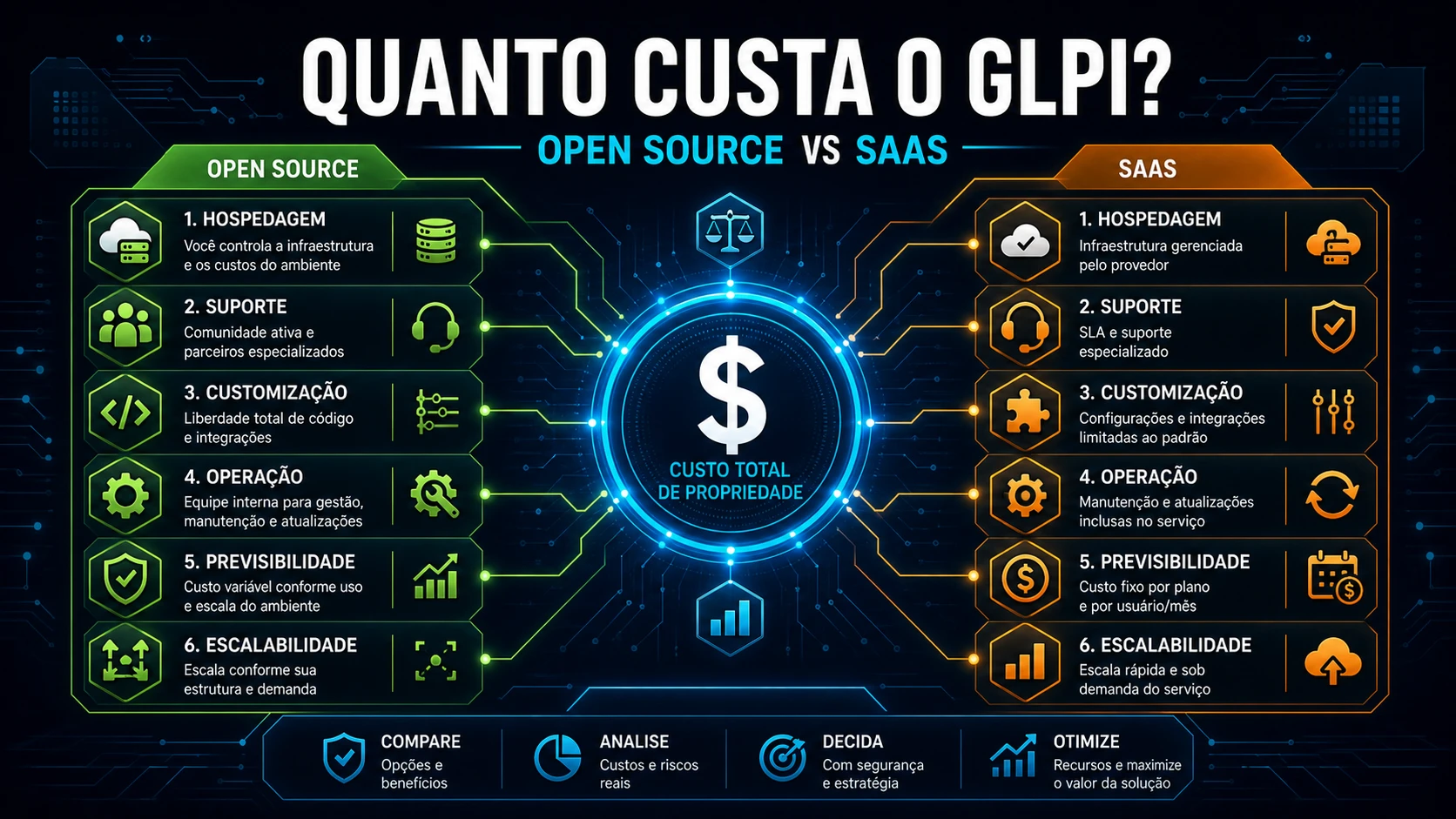
Commercial ITSM tools charge per agent - the technician who handles the ticket - not per requester, the person who opens it. That is the axis that changes everything: an operation with 8 technicians serving 1,200 users pays for 8 seats, not 1,208. GLPI charges for no seat at all - not agents, not requesters, not inventoried assets - so its "price" moves entirely to the other side of the bill: infrastructure, upgrades and maintenance.
That is why the honest comparison is not "US$ 0 vs US$ X per month". It is "cost of running self-hosted vs cost of seats, plus whatever the commercial tool will not let you do". Both columns have a number; the difference is where the money shows up - and who carries the operational responsibility.
Head-to-head comparison
| Criterion | GLPI (self-hosted) | ServiceNow | Jira Service Management | Freshservice |
|---|---|---|---|---|
| License model | Open source (GPL-3.0), no seats | Per-agent subscription | Per-agent subscription | Per-agent subscription |
| Cost per agent/month | US$ 0 (self-hosted) | High (tens to 100+ USD) | Mid (~15 to 60 USD per tier) | Mid (~15 to 90 USD per tier) |
| Requesters | Unlimited, no cost | Included | Included | Included |
| Hosting | Self-hosted or Cloud (Teclib) | SaaS (cloud) | SaaS (Cloud) or Data Center | SaaS (cloud) |
| Incident and request | Native | Native, very robust | Native | Native |
| CMDB | Native, in the core | Native (strong) | Add-on (Assets/Insight) | Native (higher tiers) |
| Automatic inventory | GLPI Agent, native and free | Discovery (paid product) | Via integrations and apps | Native Discovery |
| Automation and workflow | Native business rules | Very strong (Flow Designer) | Strong (Atlassian automation) | Good (workflow automator) |
| Extensibility | Hundreds of plugins + REST API | Apps store | Atlassian Marketplace | Freshworks Marketplace |
| Data sovereignty / on-premises | Yes, data on your server | No (SaaS only) | Yes, via Data Center (separate) | No (SaaS only) |
| Who keeps it running | Your team or a partner | The vendor | The vendor | The vendor |
| Best for | ITSM + assets with cost and data control | Enterprise with heavy automation | Atlassian and DevOps teams | Low-friction SaaS support |
Per-seat prices change often and vary by tier, region and volume - treat the ranges above as orders of magnitude and confirm on each vendor's official pricing before deciding. What does not change is the model: commercial tools charge per agent; GLPI does not.
The number that decides: how many agents you have
Before asking any commercial vendor for a quote, find out how many agents you really have - because that is exactly what they will charge for. In GLPI, an "agent" is a user with a central-interface profile; requesters use the helpdesk interface and are unlimited. This query gives the number straight from the database:
-- How many "agents" would you pay for in a commercial per-seat tool?
-- Commercial tools (ServiceNow, Jira SM, Zendesk) charge per AGENT/technician,
-- not per requester. In GLPI an "agent" is a user with a central-interface
-- profile; requesters (helpdesk interface) are unlimited and free.
SELECT COUNT(DISTINCT u.id) AS agents_central
FROM glpi_users u
JOIN glpi_profiles_users pu ON pu.users_id = u.id
JOIN glpi_profiles p        ON p.id = pu.profiles_id
WHERE p.interface = 'central'
  AND u.is_active  = 1
  AND u.is_deleted = 0;

-- Who those agents are, by profile:
SELECT p.name AS profile, COUNT(DISTINCT pu.users_id) AS agents
FROM glpi_profiles p
JOIN glpi_profiles_users pu ON pu.profiles_id = p.id
JOIN glpi_users u           ON u.id = pu.users_id
WHERE p.interface = 'central'
  AND u.is_active = 1 AND u.is_deleted = 0
GROUP BY p.id, p.name
ORDER BY agents DESC;
Multiply the result by the per-seat price range of the tool you are evaluating and compare it with the cost of keeping GLPI running. In a typical maintenance operation, requesters outnumber agents by one or two orders of magnitude - and that is exactly where GLPI's model (zero per seat) diverges from the commercial one. The more technicians, the wider the gap in GLPI's favor.
The hidden cost of self-hosting
Maintaining GLPI estates for clients, the mistake we see most is comparing the "US$ 0" of the license with the commercial monthly fee and stopping there. GLPI's cost exists - it just is not on a license invoice. It sits in three places anyone who has never operated it does not see: cron, the major-version upgrade and backups. An unconfigured cron is the classic silent failure: notifications stop going out, inventory stops updating, and nobody notices until an important ticket goes unannounced - GLPI will not tell you cron has stopped; the commercial tool runs cron for you and charges for it.
The upgrade between major versions is the real recurring cost. Going from GLPI 10 to 11 was not a "next-next-finish": it changed native inventory, retired FormCreator as a plugin (it became a core module) and required retesting the service catalog, plugins and integrations. That is why, in maintenance, we treat every major version as a project with staging validation, not as an apt upgrade. Once a client understands they are trading an invoice for operational responsibility, the decision becomes technical rather than romantic: whoever has (or outsources) that hand gains a lot with GLPI; whoever does not should look at Teclib's Cloud or a maintenance partner, which put that cost back into a predictable invoice.
Verdict by scenario
Choose GLPI when you have (or outsource) someone to look after Linux, the database and cron; when the commercial per-agent cost scales badly for your number of technicians; when inventory and CMDB are a central part of the problem, because GLPI delivers both in the core with no extra SKU; or when data sovereignty and on-premises are a compliance requirement (LGPD, GDPR).
Choose ServiceNow when the organization is large, needs heavy enterprise automation, native integrations with dozens of systems, and has budget for the premium seat model. It is the most powerful and most expensive option - and it makes sense when the problem is at that scale.
Choose Jira Service Management when the team already lives in the Atlassian ecosystem (Jira Software, Confluence) and you want ITSM glued to the engineering flow, with fast adoption and managed SaaS - or Data Center, if on-premises is a requirement.
Choose Freshservice or Zendesk when the focus is support with little operational friction and, in Zendesk's case, external customer support (CX/B2C), omnichannel and e-commerce - territory where GLPI is not the right tool. Be honest in the assessment: use the right tool for the type of support.
Cost and effort
License is not the axis of the decision, so add up the two right bills. On the commercial side: number of agents times the per-seat price (the ranges above change often), plus deployment and integrations. On the GLPI side: infrastructure - a modest VPS sustains small and mid-sized operations, with MariaDB, cron and HTTPS - plus the time of whoever installs, upgrades and maintains it. The honest range: for a small operation with few technicians, self-hosted GLPI comes out at a fraction of commercial seat costs; as the number of agents grows, that gap widens in GLPI's favor, provided the operating hand exists. If you just want to try it, a test install via Docker takes less than ten minutes and costs nothing.
At NexTool we deploy and maintain GLPI for clients that previously ran commercial tools - and we run the reverse path too. If you want the economics of open source without inheriting the hidden cost of cron, upgrades and backups, our GLPI maintenance service takes that operational responsibility off your hands.
Reviewed by the NexTool Solutions team.